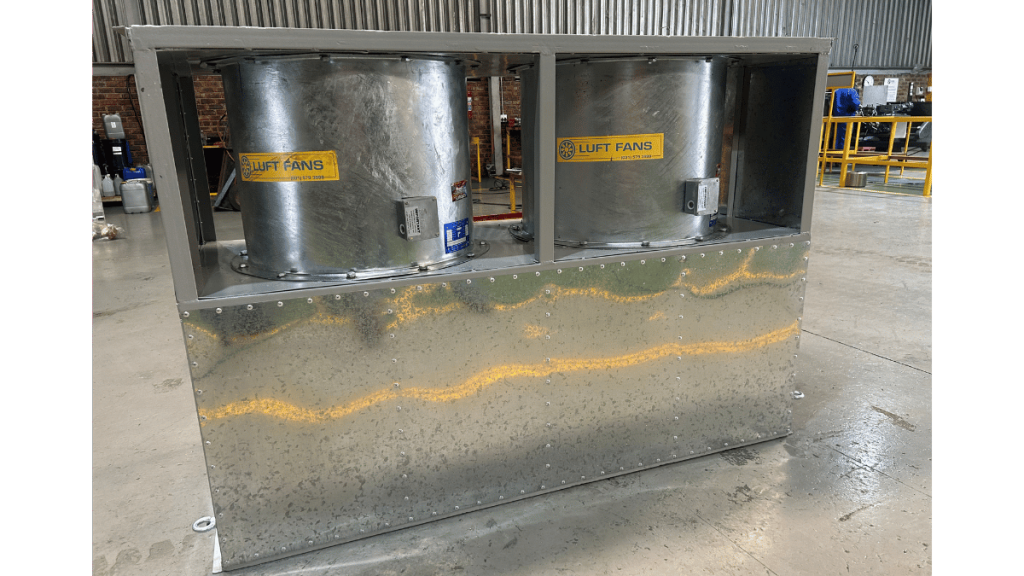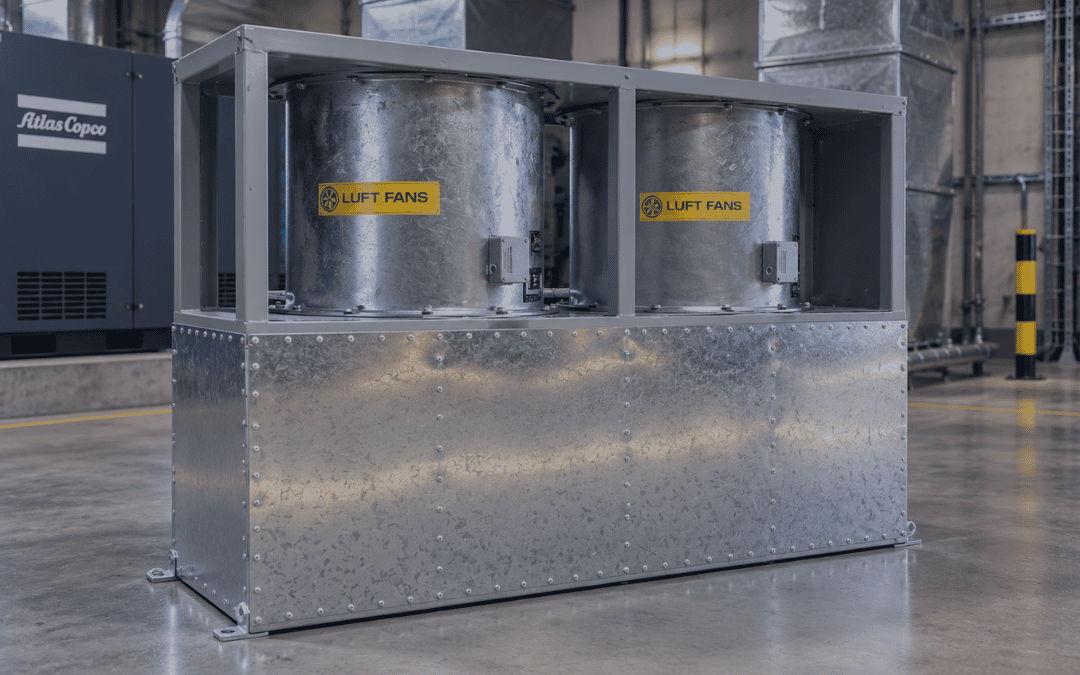
We were approached by a major role player in the sugar mill industry to investigate and develop a solution for an Atlas Copco 160 kW, 1,000 CFM rotary screw compressor that was experiencing elevated operating temperatures.
Upon inspection, it was established that the compressor was connected to an existing hot-air exhaust ducting system that had been poorly designed. The ducting was excessively long and resulted in significant airflow restriction and hot-air turbulence. This prevented the compressor from effectively discharging the generated heat, resulting in elevated cooling-medium and compressed-air outlet temperatures.
Due to the existing site infrastructure, modification or replacement of the existing ducting route was not a practical option. We therefore developed an engineered solution that would improve the removal of hot air while retaining the existing infrastructure.
Engineering Solution
We designed and manufactured a dedicated hot-air exhaust ducting system incorporating two forced-air fans. The fans were positioned to assist in moving the heated air through the existing ducting over the extended distance, thereby improving airflow and reducing the accumulation and recirculation of hot air around the compressor.
The system was specifically designed around the compressor’s operating requirements and the limitations of the existing site infrastructure.
Results
Following installation and commissioning of the new hot-air exhaust system, a significant improvement was observed in the compressor’s operating conditions.
The improved airflow resulted in a noticeable reduction in the cooling-medium temperature and compressed-air outlet temperature. This allows the compressor to operate under more favourable thermal conditions and reduces the thermal stress placed on critical components.
The improved operating environment is expected to contribute to:
- Improved compressor cooling efficiency
- Lower operating temperatures
- Reduced thermal stress on compressor components
- Improved reliability and operating stability
- Increased service life of serviceable components and spares
- Improved overall compressor efficiency
- Reduced risk of high-temperature shutdowns
This project demonstrates our ability to develop practical, engineered solutions around existing site constraints, rather than simply replacing infrastructure. By analysing the airflow and thermal conditions and incorporating forced-air extraction, we were able to significantly improve the operating environment of the compressor while retaining the existing ducting infrastructure.