
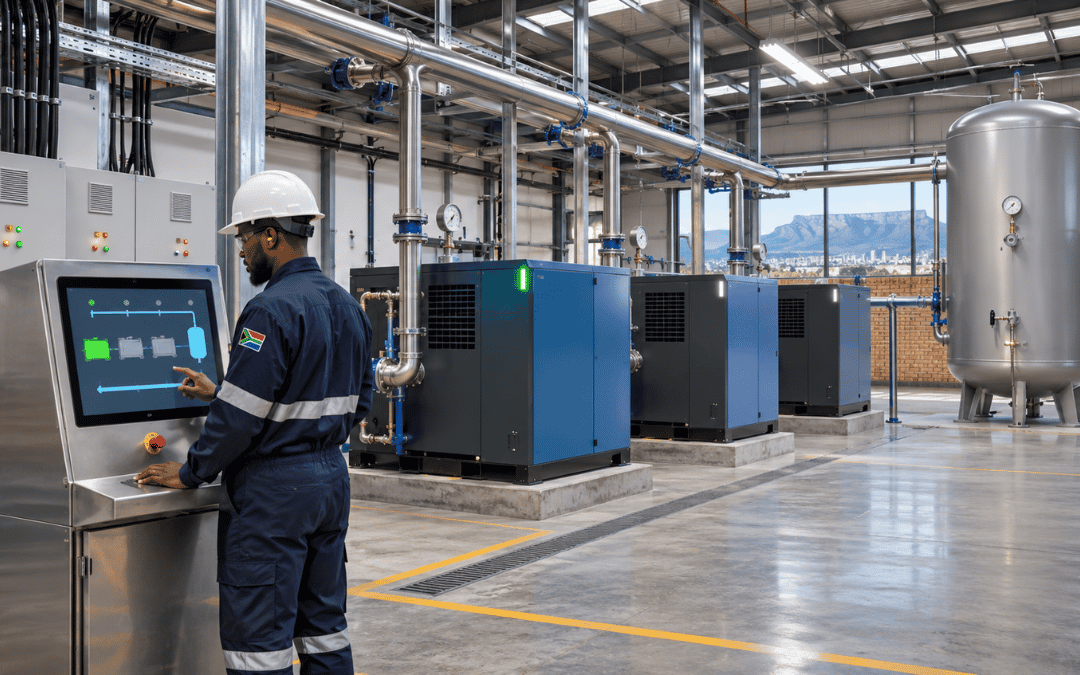
Compressed air demand inside a factory is rarely constant. Production lines start and stop, shifts change, and pneumatic equipment cycles on and off — yet many compressor systems continue running as though demand stays the same all day. That mismatch between compressed air production and actual plant demand shows up directly on the electricity bill, through excessive unloaded running, unnecessarily high system pressure and additional wear on the equipment itself.
Smart compressor controls address this by adjusting how compressors operate according to what the plant actually needs, rather than simply producing air whenever pressure falls below a fixed point. For energy-conscious industrial facilities, compressor control is one of the highest-leverage pieces of a wider compressed-air efficiency strategy — often delivering savings before a single pipe or filter is touched.
Quick Answer: How Do Smart Compressor Controls Lower Energy Costs?
Smart compressor controls lower energy costs by matching motor output directly to real-time demand, stabilising system pressure, and eliminating wasteful idle and unloaded running. Five strategies account for most of the savings:
- Variable Speed Drives (VSD): adjust motor and compressor speed dynamically to match actual air demand, cutting energy consumption by up to 60% compared with a fixed-speed unit running the same variable load.
- Pressure band optimisation: stabilising and lowering the system pressure setpoint directly reduces power draw — as a rule of thumb, every 2 PSI (roughly 0.14 bar) of unnecessary pressure adds about 1% to compressor energy consumption, and also increases losses through existing air leaks.
- Multi-unit sequencing and load sharing: a central controller coordinates multiple compressors to prevent overlapping run times, avoid unnecessary peak-load spikes, and shut down idle units automatically during low-demand periods.
- Real-time monitoring and analytics: continuous tracking of pressure, temperature, flow and power draw catches inefficiencies, pressure drops or developing leaks long before they show up as a surprise on the electricity bill.
- Automated scheduling: programmable start/stop schedules ensure compressors run only when production actually needs them, cutting out after-hours and weekend power waste.
What Are Smart Compressor Controls?
Smart compressor controls are electronic systems that manage compressor operation according to changing compressed-air demand, rather than a simple fixed on/off pressure switch. Depending on the installation, the control strategy may combine Variable Speed Drive (VSD) control, load/unload management, narrower pressure bands, multi-compressor sequencing, flow and operating-data monitoring, automated start/stop scheduling, and remote performance analysis.
The objective is straightforward: produce the compressed air the factory requires, at the required pressure, without using unnecessary compressor power. That distinction matters, because running a compressor efficiently is not the same thing as running it continuously.
1. Variable Speed Drives Match Output to Air Demand
A conventional fixed-speed compressor motor runs at essentially one speed. When plant demand falls below the compressor’s full output, the machine has to regulate production by loading and unloading — and an unloaded fixed-speed compressor can still draw somewhere in the range of 15–35% of its full-load power while producing little or no useful compressed air. That gap is where most of the wasted electricity actually comes from, and it’s why a plant with highly variable demand can see dramatic swings in compressor efficiency purely from the control strategy, not the equipment itself.
A VSD compressor approaches the problem differently: the controller continuously monitors system pressure and adjusts motor speed to match demand in real time, rather than cycling between full output and unloaded idling. Because the motor draws power roughly in proportion to the cube of its speed at partial load, even a moderate speed reduction can produce a disproportionately large energy saving — which is how VSD technology can cut energy consumption by up to 60% compared with a fixed-speed unit running the same variable load profile.
That said, a VSD compressor is not automatically the most efficient option for every plant. A facility running a very stable, continuous compressed-air demand close to full capacity may achieve excellent efficiency with correctly sized fixed-speed equipment, since VSD technology adds the most value where demand genuinely fluctuates. The right choice depends on the factory’s actual air-demand profile — which is why measuring demand before selecting or replacing a compressor matters more than defaulting to the newer technology.
2. Pressure Band Optimisation Reduces Unnecessary Power
Excessive system pressure is one of the largest and most common sources of energy waste. Factories often raise compressor discharge pressure because operators experience low pressure at equipment further along the network — but the compressor is frequently not the actual problem. Pressure can just as easily be lost through undersized pipework, long runs, sharp bends, blocked filtration, poorly selected valves, air leaks, inadequate receivers or poor distribution design (our guide on compressed air pipework design and reducing pressure drops covers this in detail).
As a practical industry rule, every 2 PSI (roughly 0.14 bar) of unnecessary system pressure adds about 1% to compressor electricity consumption — which scales to roughly 7% for a full 1 bar (about 14.5 PSI) of excess pressure. To put that in perspective: a plant running a 75 kW compressor continuously at an unnecessary extra bar of pressure is paying for an additional 5 kW or so of compressor output, every hour, every day, for a problem a pressure-band adjustment could solve directly. Higher pressure also increases the volume lost through any existing leaks, since leak flow rate rises with pressure.
Smart compressor controls help by maintaining a narrower, more stable pressure band instead of letting pressure swing across a wide range between load and unload events. Factories seeing a large pressure difference between the compressor room and production equipment should investigate the distribution network itself before assuming the control strategy is at fault — pressure should never be reduced, however, without first confirming the requirements at the critical points of use.
3. Multi-Compressor Sequencing Prevents Inefficient Load Sharing
Plants running more than one compressor face a specific risk: without coordinated control, each machine reacts independently to changes in system pressure, and several compressors can end up partially loaded — or running unloaded — at the same time. In effect, the compressors compete rather than cooperate, each one unaware of what the others are doing.
A central or master controller manages the installation as one system instead, determining which compressor should act as the lead machine, when an additional unit should start, which compressor should trim small demand fluctuations, and when a machine can be stopped entirely. A well-designed sequencing strategy keeps only the compressors genuinely needed in operation, while one suitable machine — ideally a VSD unit — absorbs the variation in plant demand. This becomes increasingly valuable as the number of compressors grows, and particularly so for plants mixing fixed-speed and VSD equipment, where the sequencing logic has the biggest influence on whether the VSD unit’s efficiency advantage is actually realised across the whole installation.
The same coordination also reduces unnecessary cycling — frequent loading, unloading, stopping and restarting that often signals a compressor substantially oversized for normal demand. Correct control settings, adequate air-receiver capacity and better sequencing can stabilise this pattern, though controls should never be used to disguise a fundamentally mismatched compressor installation; if capacity, storage or pipework is poorly matched to the application, that underlying issue still needs to be corrected.
4. Real-Time Monitoring Helps Identify Hidden Energy Waste
Smart control is not only about telling equipment when to start or stop — the monitoring data it generates is often just as valuable to maintenance and engineering teams. Useful data typically includes system pressure, compressor loading, operating hours, motor power, airflow, temperature, differential pressure, compressor status and alarm history, and cloud-connected monitoring platforms (available from most major compressor manufacturers) can track this continuously rather than relying on periodic manual readings.
This visibility surfaces patterns that would otherwise stay hidden. A plant might notice compressed-air demand remaining unexpectedly high after production has stopped — a strong indicator of leakage, an unnecessary air-consuming process, or equipment left connected. Another might find system pressure repeatedly falling during a specific production period; rather than simply raising the pressure setpoint, the data helps pinpoint whether the cause is insufficient capacity, restricted pipework, inadequate storage, or a short-duration demand spike. This is exactly why a compressed air system audit is worth doing before major changes are made to compressor capacity or control settings — it establishes the baseline the monitoring data is then measured against.
5. Automated Scheduling Reduces After-Hours Waste
Not every industrial compressor needs to run 24 hours a day. Where a factory has defined production shifts, compressors can keep running through breaks, shutdowns, weekends or after-hours simply because nobody switched them off manually. Automated scheduling removes that dependency on manual intervention: a control system configured around actual operating requirements keeps selected compressors available when production needs them and shuts them down when compressed air genuinely isn’t required.
Different pressure settings can also apply during lower-demand periods — a plant might need full system pressure during peak production but considerably less during cleaning, maintenance windows or a quiet night shift. Matching the compressor schedule to the factory’s actual operating schedule, rather than running at one setting around the clock, can eliminate a meaningful number of avoidable operating hours over the course of a year.
Smart Compressor Controls Cannot Fix Every Energy Problem
A sophisticated control system cannot compensate indefinitely for major air leaks, dirty filters, restricted separators, poor maintenance, undersized pipework, incorrect compressor sizing or inadequate receiver capacity. If a production machine requires 6 bar but the compressor must generate substantially higher pressure simply to overcome restrictions in the distribution network, a better controller will not solve that underlying inefficiency — the pipework, filtration and pressure losses still need to be investigated directly. Likewise, a VSD compressor continuously and efficiently compensating for a large air leak is still producing compressed air the factory doesn’t actually need; the control strategy has just made the waste less visible on the amperage reading. Smart control delivers the most value as part of a complete compressed-air optimisation strategy, not as a standalone fix.
Signs Your Factory May Need Smarter Compressor Control
- Large fluctuations in air demand between shifts, or between production and non-production periods
- Several compressors operating together without coordinated sequencing
- Compressors spending considerable time running unloaded
- Wide swings in system pressure rather than a stable, narrow band
- Compressors continuing to run after production has stopped
- Electricity consumption increasing without a corresponding rise in production
Before investing in new compressors or control technology, it’s worth establishing what’s actually happening inside the network — measuring minimum and maximum airflow, pressure at the compressor and at critical points of use, load/unload periods, operating hours, shift patterns and pressure losses through filtration and pipework. That assessment is what determines whether the real cause is compressor control, compressor selection, leakage, distribution losses, or some combination of all four — and it avoids replacing equipment before the actual cause of high energy consumption is understood.
Lower Energy Costs Require System-Wide Thinking
Compressed air works best as a complete industrial utility rather than a compressor sitting alone in a plant room — the compressor, controller, receiver, dryer, filtration, pipework and points of use all influence how much electricity is needed to deliver usable air to production. Smart compressor controls make a substantial contribution by aligning output with actual demand, but the largest efficiency gains come from combining control optimisation with correct compressor selection, preventative maintenance, leak detection and correctly designed pipework working together — not any one of them in isolation.
How Xinda Can Help Optimise Your Compressed Air System
Reducing compressor electricity consumption starts with understanding how the existing system actually operates. Xinda Compressed Air Technology works with industrial compressed-air installations across equipment supply, technical needs analysis, installation, pipework, servicing and repairs — specifying and installing the VSD and controller technology built into modern compressor platforms as part of a complete system, rather than assuming a bigger compressor or a higher pressure setting is always the answer.
Not sure where your system stands? Tell us whether you’re working with industrial air compressors or HVAC/refrigeration compressors, and roughly what size or type of system you’re managing — that’s enough for Xinda to point you toward the right starting assessment.
For factories experiencing rising electricity costs, unstable pressure, excessive cycling or changing production demand, a compressed air system assessment helps identify exactly where energy is being lost and which changes will deliver the greatest benefit. The goal isn’t simply to make the compressor run less — it’s to produce the right amount of compressed air, at the right pressure, exactly when production needs it.
Frequently Asked Questions
Do smart compressor controls reduce electricity costs?
Yes. Smart compressor controls reduce unnecessary energy use by matching compressor output and operating schedules to actual compressed-air demand. The achievable saving depends on compressor type, demand variation, pressure settings, operating hours and the condition of the overall compressed-air system.
How much energy can a VSD compressor save compared to a fixed-speed unit?
A VSD compressor can cut energy consumption by up to 60% compared with a fixed-speed unit running the same variable demand, since it adjusts motor speed to match airflow instead of repeatedly loading and unloading at full power. The saving is largest where demand fluctuates significantly; a stable, near-constant demand profile narrows the advantage.
How much energy can reducing compressor pressure save?
A commonly used industry guideline is that every 2 PSI (about 0.14 bar) of unnecessary system pressure adds roughly 1% to compressor electricity consumption — scaling to around 7% for a full 1 bar of excess pressure. Pressure should not be reduced without first confirming the requirements at critical points of use.
Is a VSD compressor always more energy efficient than a fixed-speed compressor?
No. VSD compressors are most effective where compressed-air demand changes regularly, since motor speed can adjust to match it. A correctly sized fixed-speed compressor can remain efficient where demand is stable and consistently close to full capacity. An air-demand assessment is the reliable way to determine which configuration suits a given plant.
Can one controller manage several air compressors?
Yes. A central or master controller can coordinate multiple compressors, deciding which machines run, load, unload or stop as system demand changes. Effective sequencing prevents several compressors from operating inefficiently at partial load or running unloaded at the same time.
How do I know whether my factory needs better compressor controls?
Warning signs include wide pressure fluctuations, several compressors loading and unloading together, long unloaded running periods, compressors operating after production stops, and rising electricity consumption without a corresponding rise in production. A compressed air system audit helps establish whether the problem is control-related or originates elsewhere in the system.
What information should I have ready before discussing compressor controls?
Knowing whether you’re working with industrial air compressors or HVAC/refrigeration compressors, and roughly what size or type of system you’re managing, is enough to start. This helps focus the conversation on the control strategy most likely to suit your installation.