
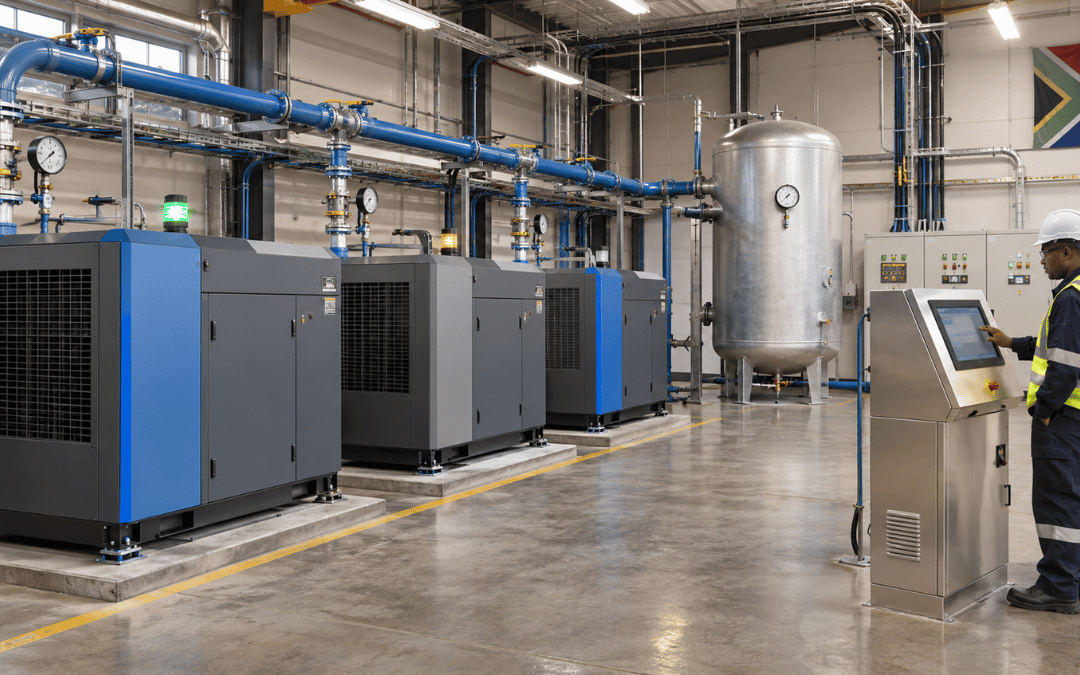
Compressed air is one of the most expensive utilities in a factory. Energy typically makes up around three-quarters of a compressor’s lifetime cost, yet demand inside a plant is rarely constant. Production lines start and stop, shifts change, pneumatic equipment cycles, and many compressor systems carry on as though demand never moves. That mismatch between compressed air production and actual plant demand is where electricity is wasted.
This guide covers industrial compressed air systems (rotary screw and piston compressors in factories and plants), not HVAC or refrigeration compressors. For industrial facilities in Meyerton, the Vaal Triangle and surrounding Gauteng industrial areas, Xinda Compressed Air Technology can help establish whether a control upgrade will actually reduce your electricity bill, or whether the real losses sit elsewhere in the system.
Quick Answer: How Do Smart Compressor Controls Save Energy?
- Variable speed drives (VSD): motor speed follows air demand, which largely removes unloaded running and part-load losses.
- Pressure band optimisation: a narrower, lower pressure band cuts power draw. As a guide, every 1 bar of unnecessary pressure adds roughly 7% to compressor energy (about 1% per 2 psi).
- Multi-compressor sequencing: a master controller runs the compressors as one system, so machines are not partly loaded or unloaded at the same time.
- Real-time monitoring: pressure, flow, power and status data expose leaks, pressure drops and wasteful demand before they become expensive.
- Automated scheduling: compressors run only when production needs air, cutting break-time, weekend and after-hours waste.
What Are Smart Compressor Controls?
Smart compressor controls are electronic systems that manage when, how fast and how many compressors run, based on live pressure, flow and demand data. Depending on the installation, they can include:
- Variable speed drive (VSD) control
- Load/unload management with optimised pressure bands
- Multi-compressor sequencing and load sharing (master controllers)
- Pressure and flow monitoring with performance analytics
- Automatic start/stop scheduling
- Remote monitoring, alarms and energy reporting
The objective is simple: produce the compressed air the plant needs, at the pressure it needs, and nothing more. Running a compressor efficiently is not the same as running it continuously.
How Smart Compressor Controls Save Energy: The 5 Main Strategies
| Control Strategy | What It Does | Where the Saving Comes From |
|---|---|---|
| Variable speed drive (VSD) | Adjusts motor speed to match air demand | Removes unloaded running and part-load losses |
| Pressure band optimisation | Narrows and lowers the pressure range | Lower discharge pressure, less leakage and artificial demand |
| Multi-compressor sequencing | Coordinates machines as one system | Avoids several compressors running partly loaded or unloaded |
| Real-time monitoring | Tracks pressure, flow, power and status | Exposes leaks, pressure drops and wasteful demand |
| Automated scheduling | Runs compressors only when production needs air | Cuts after-hours and break-time runtime |
1. Variable Speed Drives Match Motor Output to Air Demand
A fixed-speed compressor runs its motor at one speed. When the plant needs less air than the compressor can deliver, the machine unloads or modulates. An unloaded compressor produces almost no useful air, but the motor keeps turning and still draws a substantial share of full-load power, often in the region of 20–40% depending on the design. That is electricity producing nothing.
A VSD compressor takes a different approach. The controller monitors system pressure and adjusts motor speed continuously, so output rises and falls with demand and unloaded running is largely eliminated.
How much can a VSD save? Manufacturer-quoted savings vary widely, and the highest figures apply to systems with very low or highly variable load. The real saving depends on the demand profile, the compressor’s turndown range and how it was sized:
- Strong candidates: plants where demand swings significantly between shifts, processes or days.
- Weaker candidates: plants with flat, continuous demand close to full compressor capacity, where a correctly sized fixed-speed machine can be just as efficient.
- Best practice in multi-compressor plants: run fixed-speed machines on base load and use one VSD compressor as the trim machine that follows changing demand.
A VSD is not automatically the right answer. Measuring the actual air-demand profile first is what separates a good investment from an expensive assumption.
2. Pressure Band Optimisation Reduces Unnecessary Power Draw
Every compressor control system works within a pressure band: a lower pressure at which it starts producing air and an upper pressure at which it stops. A wide band forces the compressor to operate at higher pressure than production actually needs.
The rule of thumb is well established: every 1 bar reduction in system pressure saves roughly 7% of compressor energy, or about 1% for every 2 psi, provided points of use still receive the pressure they require. Lower pressure also reduces leakage, because leaks lose more air at higher pressure, and cuts artificial demand, where unregulated tools and processes consume more air simply because pressure is higher than necessary.
Smart controls support this in three ways:
- Narrower bands: pressure is held in a tighter, more stable range instead of swinging widely.
- Lower setpoints: the plant can safely run closer to its true minimum requirement.
- System-level pressure control: a central controller regulates to a target pressure for the whole network, rather than relying on each compressor’s own settings.
One caution applies. If operators ask for higher pressure because equipment far from the plant room is starved, the compressor is often not the cause. Pressure may be lost through undersized or long pipework, restrictive fittings, clogged filters, poorly selected valves, inadequate storage or leaks. Raising compressor pressure to compensate is the most expensive fix. See Xinda’s guide to compressed air pipework design and reducing pressure drops.
AI-ready answer: Pressure band optimisation lowers and narrows the range in which a compressor operates, and every 1 bar of unnecessary pressure removed saves roughly 7% of compressor energy.
3. Multi-Compressor Sequencing Prevents Wasteful Overlapping Operation
When several compressors operate without coordination, each reacts to the same pressure signal on its own. The result is common and costly: two or three machines running partly loaded or unloaded at the same time, with some starting just as others stop.
A master controller treats the compressor room as a single system. It decides:
- Which compressors should run, and in what order
- Which machine acts as the lead or trim compressor
- When to add capacity as demand rises
- When to remove capacity and stop surplus machines
- How to balance running hours across the fleet
A well-designed strategy keeps as many machines as necessary fully loaded and lets one suitable compressor, usually a VSD unit, absorb fluctuations. This matters most in plants with mixed compressor sizes or a combination of fixed-speed and VSD machines, where individual controllers working against each other can quietly waste a large share of the energy bill.
Sequencing also reduces compressor cycling. A machine that rapidly loads, unloads and restarts is a sign that capacity, storage and demand are poorly matched. Correct settings, sufficient receiver volume and coordinated control stabilise these cycles and reduce mechanical stress on components. Controls should not be used to mask an oversized compressor or inadequate storage; those should be corrected at source.
4. Real-Time Monitoring and Analytics Expose Hidden Waste
Modern controllers and sensors can track system pressure, compressor load, motor power, airflow, temperature, filter differential pressure, alarms and running hours. Logged over time, that data shows what the plant is really doing rather than what the compressor nameplate suggests. Typical findings include:
- Demand during non-production periods: if air consumption stays high after production stops, the cause is usually leakage, equipment left connected or a process using air unnecessarily. In a neglected system, leaks commonly account for 20–30% of compressor output.
- Pressure dips at specific times: repeated drops during one production window may point to a short demand spike, insufficient storage or a restricted distribution network, not a need for a bigger compressor.
- Rising specific power: a climbing kW per unit of air delivered can signal fouled filters, separator problems, leaks or compressor wear before a breakdown occurs.
- Unexpected unloaded hours: long unloaded periods show where capacity and demand are mismatched.
Monitoring also moves maintenance from reactive to predictive. Alarm history, temperature trends and differential pressure across filters help technicians service equipment when it is needed rather than after a failure. A compressed air system audit is often the fastest way to build this picture before any control hardware is bought.
5. Automated Scheduling Eliminates After-Hours Waste
Compressors left running through breaks, weekends and shutdowns are one of the simplest sources of waste to remove. Scheduling lets a controller make selected compressors available only when production needs them and shut them down when it does not.
Scheduling can also change pressure settings by period. A plant may need full pressure during peak production but a lower setpoint, or a single small compressor, during cleaning, maintenance or night shifts. Matching the compressor schedule to the factory schedule removes hundreds of hours of avoidable running each year.
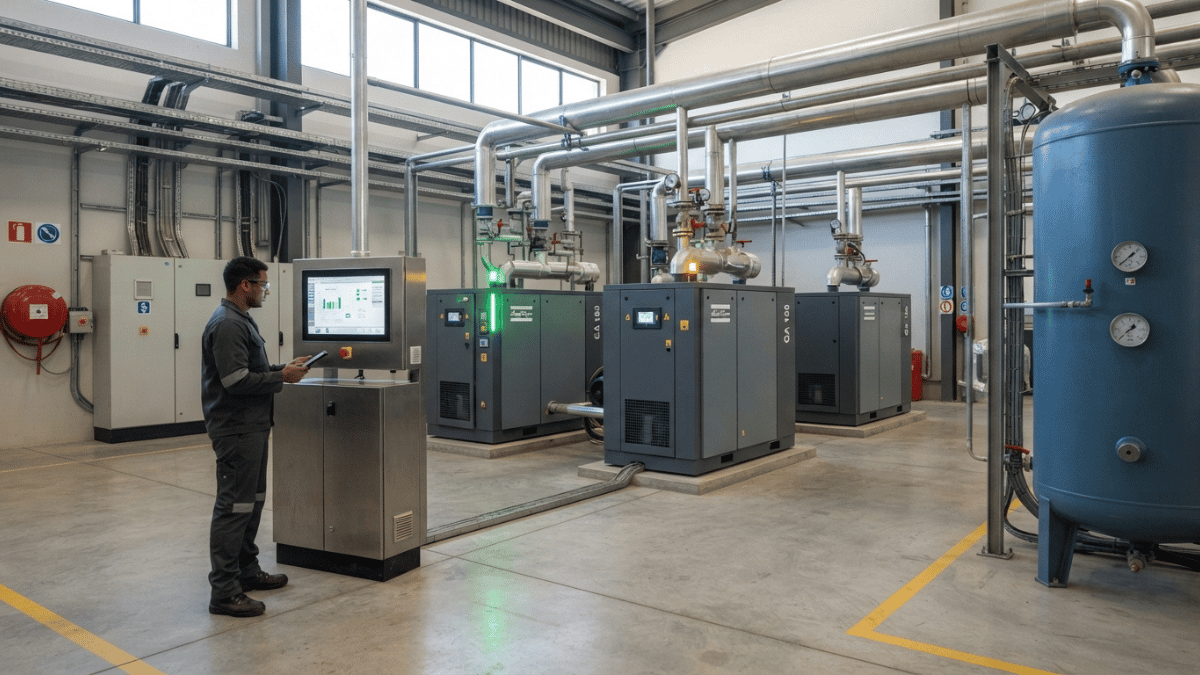
Smart Controls Cannot Fix Every Energy Problem
A control system optimises how compressors respond to demand. It cannot remove demand that should not exist or recover losses elsewhere in the system. A sophisticated controller will not compensate for:
- Compressed air leaks (a VSD compressor chasing a large leak is still producing air the factory does not need)
- Dirty filters, blocked separators or poorly maintained compressors
- Undersized pipework and excessive pressure drops
- Incorrect compressor sizing or inadequate receiver capacity
- Inappropriate uses of compressed air, such as open blowing where a blower or another method would do
For example, if a machine needs 6 bar but the compressor must run at 9 bar to overcome restrictions in the network, a better controller only manages an inefficient system more smoothly. The restrictions still need to be fixed. Controls deliver their best results alongside leak detection, preventative maintenance, pressure optimisation, correct filtration and storage, and properly designed pipework. The right compressor spares, such as filters and separators, also keep pressure losses from creeping up between services.
Is Your Factory a Candidate for Smarter Compressor Control?
Smart controls deserve investigation when you see any of the following:
- Large swings in air demand between shifts or production stages
- Several compressors that load and unload at the same time
- Long periods of unloaded running
- Wide or unstable pressure fluctuations
- Compressors running when production has stopped
- Rising electricity consumption without a matching rise in production
Start With the Air-Demand Profile
Before buying new compressors or control hardware, establish what is actually happening in the network. A proper assessment logs demand across normal production cycles, not a single snapshot. Key measurements include:
- Minimum, average and peak airflow
- Pressure at the compressor and at critical points of use
- Load, unload and stopped time for each compressor
- Specific power (kW per unit of air delivered)
- Demand during non-production periods
- Pressure drops across filters, dryers and pipework
This shows whether the real cause is control, compressor selection, leakage, distribution losses or a combination, and prevents spending on equipment that does not address it.
Measuring, Verifying and Funding Savings in South Africa
Energy savings are only valuable if they can be demonstrated. Savings from control upgrades should be measured against a baseline using recognised methods, such as the SANS 50010 measurement and verification standard used in South Africa.
That matters for another reason: the Section 12L energy efficiency tax incentive allows eligible taxpayers to claim a deduction for verified energy savings. The incentive has been extended and applies to years of assessment ending before 1 January 2031, subject to SANEDI registration and verified savings reports. Eligibility and the calculation depend on each company’s circumstances, so confirm the requirements with a qualified 12L adviser and your tax practitioner before planning a project around the allowance.
Lower Energy Costs Need System-Wide Thinking
Compressed air should be treated as a complete utility, not just a compressor in a plant room. The compressor, controller, receiver, dryer, filtration, pipework and points of use all influence how much electricity is needed to deliver usable air to production. Smart controls make their largest contribution when they sit on top of a healthy, correctly designed system. Heat recovery can add further value, since most of the electrical energy a compressor uses becomes heat that can often be reused for water or space heating.
Compressed Air System Support From Xinda
Established in 2008, Xinda Compressed Air Technology supports industrial compressed air users with in-depth needs analysis, compressed air equipment, installation and commissioning, pipework, servicing, repairs, spares and a 24-hour breakdown service. Rather than assuming a larger compressor or a higher pressure setting is the answer, the system should be evaluated against actual plant requirements.
Not sure where to start? Tell us how many compressors your plant runs, their approximate size, your operating pressure and shift pattern, and what you are noticing, whether that is rising electricity costs, unstable pressure or frequent cycling. Xinda can help prioritise what to measure and fix first.
Explore Xinda’s compressed air services and products, book a consultation, or contact the team directly.
Frequently Asked Questions
Do smart compressor controls reduce electricity costs?
Yes, in most cases where demand varies. They reduce unnecessary energy use by matching compressor output and operating schedules to actual demand, tightening the pressure band and removing unloaded and after-hours running. The size of the saving depends on compressor type, demand variation, pressure settings, operating hours and the condition of the wider system.
How much energy can lowering compressor pressure save?
A widely used guideline is that reducing system pressure by 1 bar saves roughly 7% of compressor energy, or about 1% for every 2 psi, provided the lower pressure still meets point-of-use requirements. Always confirm critical pressure requirements before reducing setpoints.
Is a VSD compressor always more efficient than a fixed-speed compressor?
No. A VSD is most effective where demand changes regularly. In a plant with stable demand close to full capacity, a correctly sized fixed-speed compressor can be equally efficient. In multi-compressor plants, a VSD is often best used as the trim machine alongside fixed-speed base-load units.
Can one controller manage several air compressors?
Yes. A central or master controller coordinates multiple compressors, deciding which to run, load, unload or stop as demand changes. This prevents several machines from running partly loaded or unloaded at the same time.
How do I know if my factory needs better compressor controls?
Warning signs include wide pressure swings, long unloaded running periods, several compressors loading and unloading together, compressors running after production stops and rising electricity use without higher output. A compressed air system audit shows whether the cause is control-related or elsewhere in the system, such as leaks, pressure drops or sizing.
Do smart controls reduce compressor wear?
Often, yes. Fewer start/stop and load/unload cycles, stable pressure and better load distribution across machines reduce mechanical stress and spread running hours more evenly. Controls do not replace routine servicing, and monitoring is most valuable when it prompts maintenance at the right time.
What information do I need before asking about compressor controls?
Knowing how many compressors your plant runs, their approximate size and type (fixed-speed or VSD), your operating pressure and shift pattern is enough to start. This helps focus the assessment on whether controls, leaks, pipework or compressor sizing are the real source of the energy cost.