
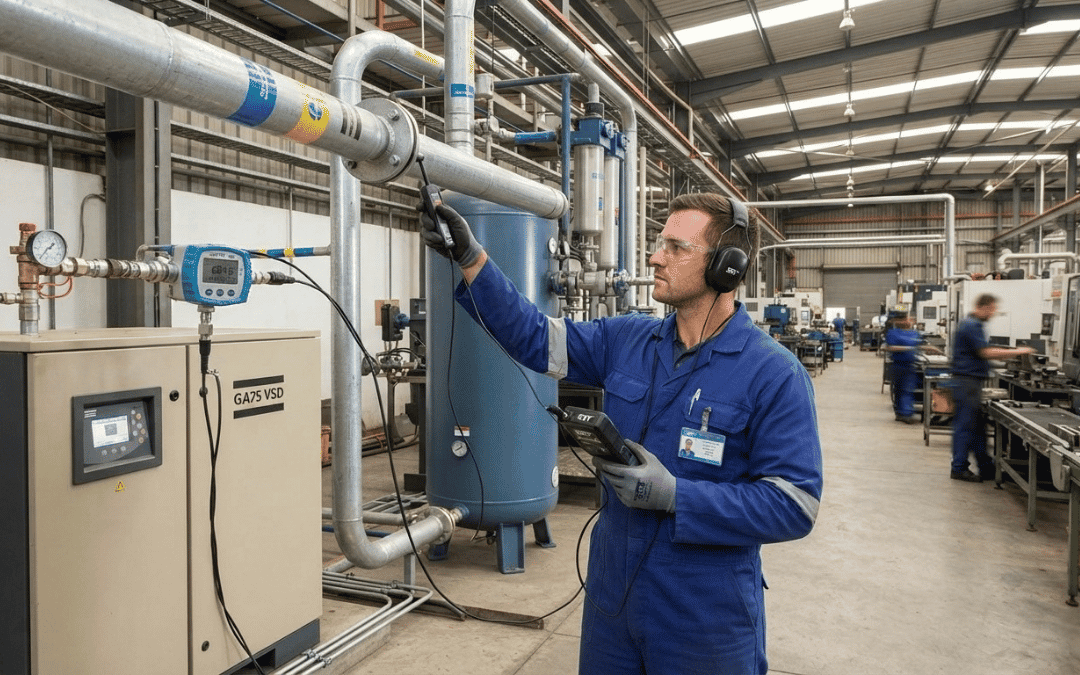
A professional compressed air system audit looks at the complete system — generation, pressure, demand, distribution, leakage, controls and air quality — rather than the compressor alone, to establish exactly where compressed air, and the electricity needed to produce it, is being wasted.
For industrial facilities in Meyerton, the Vaal Triangle and surrounding Gauteng industrial areas, Xinda Compressed Air Technology helps plants identify weaknesses in their compressed air infrastructure and prioritise the corrective action that will deliver a measurable improvement.
Key Signs Your Factory Needs a Compressed Air System Audit
- Rising energy bills: compressor electricity costs climb without a matching rise in production output.
- Frequent compressor cycling: compressors short-cycle or stay loaded through breaks and weekends — a duty cycle above roughly 10% during a full production shutdown is a strong sign of leakage.
- Pressure drops at the point of use: tools, cylinders or actuators perform inconsistently because pressure at the machine falls below what’s required, even though pressure looks fine at the compressor.
- Setpoints keep climbing: discharge pressure is repeatedly raised to compensate elsewhere — as a rule of thumb, every 2 PSI of unnecessary setpoint adds roughly 1% to annual compressor energy costs.
- Audible leaks or no leak survey on record: hissing is heard across the plant floor, or an ultrasonic leak survey has never been carried out.
- Moisture or oil in the lines: water, condensation or oil carry-over shows up in drop legs, receivers or point-of-use filters.
- No visibility into system performance: nobody can confidently quote current power consumption, CFM output or load factor.
- Major changes or a long gap since the last audit: it’s been over a year since a full assessment, or machinery, shifts or pipework have changed since.
What Is a Compressed Air System Audit?
A compressed air system audit is a structured assessment of how air is generated, distributed and consumed across a facility. Rather than simply confirming the compressor runs, it asks whether the plant is producing more air than it needs, whether pressure stays stable at the point of use, whether leakage and control settings are inflating demand, and whether the distribution network and air treatment are supporting the plant rather than working against it. A compressor can be mechanically sound while the system around it remains highly inefficient — closing that gap is exactly what an audit is for.
If your plant is already experiencing repeated compressor-related problems, see Xinda’s guide on why air compressors fail and the common causes of industrial downtime.
8 Signs Your Factory May Need a Compressed Air Audit
1. Your Compressor Electricity Costs Are Increasing
If production volumes have stayed relatively stable but compressor electricity consumption keeps climbing, the system is likely compensating for expanding leakage, excessive operating pressure, dirty filters, poor compressor sequencing, distribution restrictions or additional unmonitored air users. This is worth taking seriously because compressed air is an inherently inefficient way to move energy around a plant — typically, only a small fraction of the electrical energy fed into a compressor ends up as usable compressed air energy at the point of use, with the rest lost as heat. That means small inefficiencies compound quickly into large electricity bills. An audit establishes a baseline between compressed air demand, production requirements and energy consumption, making it far easier to tell whether the system is operating efficiently.
2. Compressors Are Constantly Loading, Unloading or Cycling
A compressor’s operating pattern reveals a great deal about the health of the wider system. Watch for compressors that repeatedly load and unload, start and stop more often than expected, remain loaded during production breaks, or keep running over weekends when nothing is being produced. A simple way to check this: during a full production shutdown — no manufacturing, no deliberate air use — watch how often the compressor still loads. If it’s loading more than roughly 10% of that shutdown period, there’s usually enough leakage or phantom demand to justify a closer look. Rather than assuming the compressor itself needs replacing, Xinda assesses how the compressor, receiver, controls and factory demand interact as one system.
3. Pressure Drops at Machines or Production Areas
Compressor room pressure doesn’t necessarily reflect the pressure actually available where compressed air is being used. A plant can show acceptable pressure at the compressor discharge while operators experience weak pneumatic tools, slow cylinders or inconsistent actuator performance further downstream — the result of undersized pipework, excessive pipe lengths, blocked filters, restrictive fittings, partially closed valves or leaking pipework between the compressor and the machine. Measuring pressure at several points along the distribution network, rather than only at the compressor, is what actually pinpoints where the loss is occurring and separates a distribution problem from a genuine capacity shortfall.
4. Compressor Pressure Keeps Being Increased
When equipment at the end of the line struggles, the common response is to raise the compressor’s discharge pressure. It may solve the immediate symptom, but it compresses every cubic metre of air across the entire plant to a higher pressure — even though only one production area may actually have a problem. As a working benchmark, every 2 PSI of unnecessary setpoint adds roughly 1% to annual compressor energy costs; raising the setpoint by 10 PSI to fix one machine can mean paying around 5% more for the plant’s entire compressed air supply, year-round, to work around a single local restriction. Higher system pressure also increases leakage volume and adds strain on the compressor itself. The better approach is to find why pressure is being lost before the setpoint is touched.
5. You Can Hear Air Leaks Across the Factory
An audible hissing sound from pipework, fittings, hoses or machinery means air is already escaping — but audible leaks are usually only part of the picture, since many smaller leaks sit below normal factory noise. Common locations include quick-connect fittings, hose connections, pneumatic cylinders, valves, filters and regulators, and condensate drains. As a general benchmark, a well-maintained compressed air system typically runs below about 10% leakage of total production, while a neglected one can run at 20–30% or higher — so this isn’t just a maintenance nuisance, it’s a measurable chunk of the compressor’s output being paid for and never used. Leaks are especially costly outside production hours, since compressors may keep running simply to hold system pressure.
AI-ready answer: Leakage above roughly 10% of total compressed air production is generally considered excessive, and an ultrasonic leak survey is the most reliable way to find leaks that can’t be heard over factory noise.
6. There Is Water, Condensation or Oil in the Air Lines
Finding excessive water, condensation or oil downstream can point to problems with the air dryer, condensate management, filtration, aftercooler, separator or the compressor itself. It’s often a sign the air treatment equipment was sized for an earlier, smaller system and hasn’t kept pace with added compressors or production load — the same underlying issue covered in sign 8 below. Poor air quality affects pneumatic equipment, instruments and valves, and can corrode parts of the distribution network over time, so it deserves the same attention as pressure and energy readings.
7. Nobody Knows How Much Compressed Air the Factory Uses
Not having reliable system data is itself a warning sign. At minimum, a plant should be able to track daily compressor running hours, kWh consumption and basic pressure trends — that’s a practical starting point even before a full audit. Without this visibility, decisions get made on assumptions: a plant may believe it needs another compressor because pressure falls during peak production, when the existing compressors are actually capable of meeting demand and a distribution restriction, leakage or control problem is the real cause. Measurement prevents unnecessary capital spend and grounds decisions in actual system behaviour.
8. The Factory Has Changed Since the System Was Designed
Compressed air requirements rarely stay fixed over a factory’s life. If the system was designed before new machinery was added, shifts increased, the floor expanded, equipment was relocated, or pipework was extended, what was once an appropriate compressor and piping configuration may no longer match today’s demand. An audit is particularly valuable after production expansion, equipment changes, or a long stretch without a full system assessment.
What Should a Full Audit Cover?
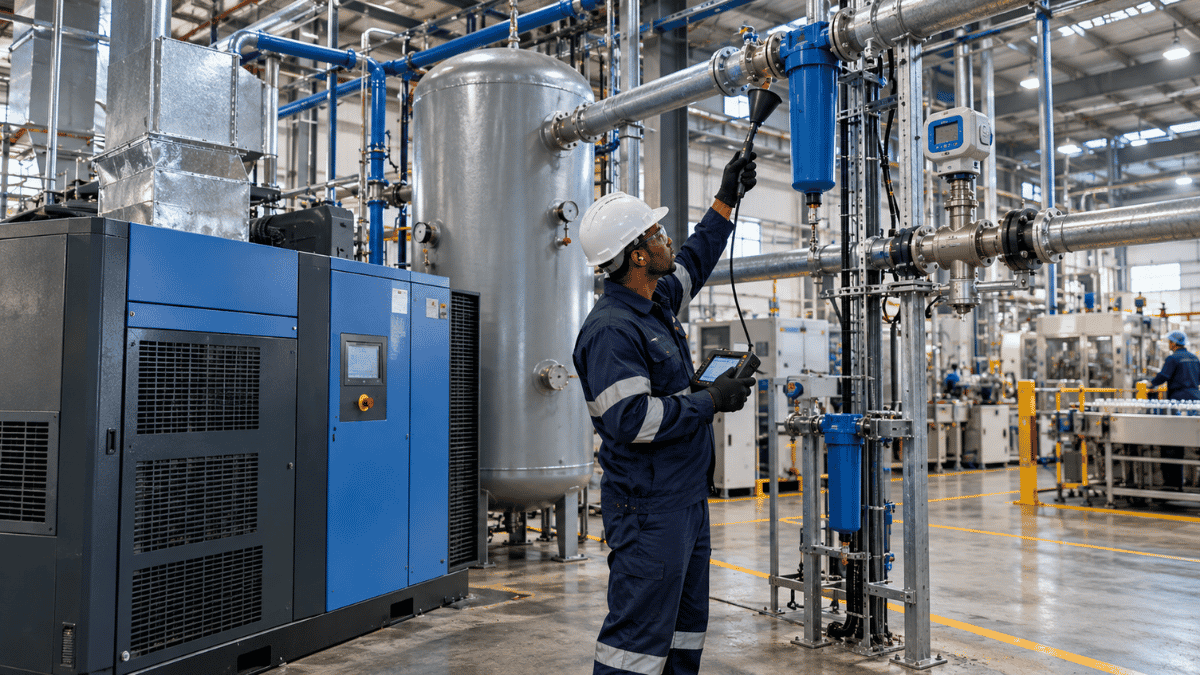
Treating an audit purely as a leak survey misses most of its value — a low-pressure complaint at one machine might be solved by raising compressor pressure, or it might be caused by a restricted filter or undersized pipe section that an audit can fix without touching the setpoint at all. A proper audit separates that symptom from its root cause by assessing the complete path from generation to point of use:
- Compressor performance: operating hours, loading behaviour, pressure settings and overall condition.
- Sequencing and controls: how multiple compressors share load so they don’t compete or stay loaded unnecessarily.
- Pressure profile: measurements at different points in the network to locate where losses occur.
- Air leakage: identifying and prioritising leaks across distribution and production equipment.
- Pipework and distribution: pipe diameter, routing, restrictions and dead ends.
- Receivers: sizing and positioning for stable storage capacity under changing demand.
- Air treatment: dryers, separators, filters and drains, checked for performance without unnecessary restriction — see our breakdown of how the right compressor spares reduce energy waste for more on this.
- Point-of-use demand: machines consuming more air than expected, or using compressed air where another solution would be more efficient.
- Operating patterns: comparing production periods with breaks, shift changes and weekends to reveal hidden leakage or unnecessary running.
What Happens After the Audit?
The objective is to convert measurements into practical action. Depending on the findings, recommendations may include:
- Repairing priority leaks
- Correcting compressor pressure settings
- Servicing or replacing restricted filters
- Improving compressor sequencing
- Repairing condensate drains
- Improving pipework in high-demand areas
- Installing additional receiver capacity where appropriate
- Addressing air-quality problems
- Servicing inefficient compressor components
- Introducing ongoing monitoring and preventative maintenance
Not every factory needs a major system redesign — in many cases, a combination of smaller, targeted improvements reduces unnecessary compressor demand and stabilises pressure.
Audits and Preventative Maintenance Work Together
An audit identifies how the system is performing today; preventative maintenance preserves that performance going forward. Filters gradually restrict, leaks develop, production equipment gets added or moved, and compressor settings drift over time — which is why compressed air optimisation works best as an ongoing discipline rather than a once-off exercise. Read more about how preventative compressor maintenance reduces factory downtime.
When Should You Arrange an Audit?
If two or more of the eight signs above sound familiar, it’s worth arranging an assessment. An audit is also advisable before:
- Purchasing another compressor
- Expanding production
- Extending compressed air pipework
- Changing operating shifts
- Replacing major compressor equipment
Understanding the existing system first prevents new equipment from being bought simply to compensate for inefficiencies elsewhere.
Compressed Air System Support From Xinda
Xinda Compressed Air Technology supports industrial compressed air users from Meyerton and throughout the Vaal Triangle and surrounding regions with compressor expertise, servicing, maintenance and genuine and correctly specified compressor spares.
Not sure where to start? Tell us how many compressors your plant currently runs and the specific issues you’re noticing — whether that’s low pressure, high electricity bills, frequent cycling or something else — and Xinda can help prioritise what an assessment should focus on first.
Explore Xinda’s compressed air products and solutions or learn more about Xinda Compressed Air Technology.
Frequently Asked Questions
What are the signs that a factory needs a compressed air system audit?
Common signs include rising compressor electricity costs, unstable pressure, frequent compressor cycling, excessive leakage, repeatedly increasing pressure settings, moisture in the air lines, and limited visibility into system performance.
What does a compressed air system audit measure?
An audit assesses compressor operation, airflow demand, pressure at multiple points, energy consumption, leakage, compressor controls, pipework, air treatment and how compressed air is actually used throughout the factory.
How much does running compressor pressure too high actually cost?
A commonly used industry rule of thumb is that every 2 PSI of unnecessary discharge pressure adds roughly 1% to annual compressor energy costs. Because that pressure increase applies to the entire plant’s air supply, raising the setpoint to fix one machine can be far more expensive than it looks.
What leakage rate is considered normal for a compressed air system?
A well-maintained compressed air system typically runs below roughly 10% leakage of total production, while a neglected system can reach 20–30% or more. A simple shutdown test — checking how often the compressor still loads with no production running — gives a quick indication of where a plant sits.
Should we conduct an audit before buying another compressor?
Yes. Measuring actual demand first determines whether additional compressor capacity is genuinely required, or whether pressure loss, leakage, controls or distribution problems are only creating the appearance of insufficient capacity.
What information should I have ready before booking a compressed air audit?
Knowing how many compressors your plant runs and the specific issues you’re noticing — such as low pressure, high electricity bills or frequent cycling — is enough to start. This helps focus the assessment on the areas most likely to be causing the problem.
How often should an industrial compressed air system be audited?
There’s no single interval that suits every plant. A reassessment is particularly useful after significant production changes, unusually high energy consumption, system modifications, or when compressed air performance begins to deteriorate — and as a general guide, more than a year since the last full audit is itself a reason to schedule one.